

Introduction
Every second, people type roughly 99,000 searches into Google alone. That’s over 8.5 billion searches every single day — and behind every one of them, a search engine is quietly doing something remarkable.
But how does it actually work? How does a website in Lahore, London, or Los Angeles end up at the top of your results when you type three words into a search box?
Understanding search engine basics isn’t just for developers or marketers. If you use the internet — whether you’re a student, a business owner, or just someone who searches for recipes — knowing how search engines work gives you a real advantage. You’ll search smarter, build better websites, and understand why some pages rank and others don’t.
This guide covers everything: what a search engine is, how it works step by step, the main components behind it, and how any website gets found online. No jargon-heavy textbook language. Just clear, honest explanations.
What Is a Search Engine?
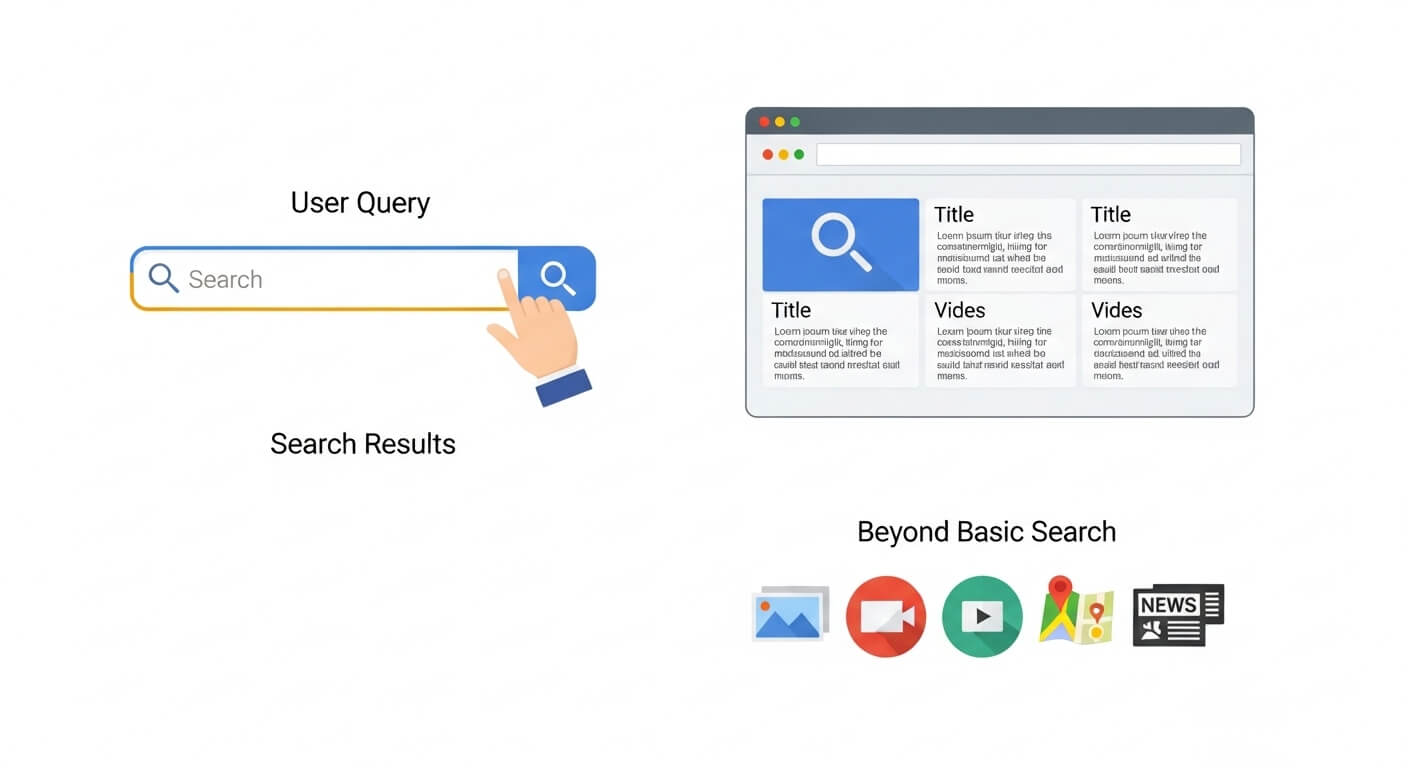
A search engine is a software system that searches a massive database of web content and returns the most relevant results for a user’s query.
Think of it like the world’s largest library catalog — except the library contains hundreds of billions of pages, updates itself continuously, and can answer your question in under a second.
The most widely used search engines as of 2026 include:
- Google — Holds over 91% of the global search market share (Statcounter, 2025)
- Bing — Microsoft’s search engine, powering several AI tools
- Yahoo — Still widely used, especially in Japan
- Baidu — Dominant in China
- DuckDuckGo — Privacy-focused, growing in popularity
- Yandex — Russia’s leading search engine
Each operates on the same core principle: crawl the web, organize what they find, and serve the best answers to users’ questions.
How Does a Search Engine Work? (Step by Step)
The process behind every search result has three distinct phases. Understanding them explains why some websites appear at the top, and others never get found at all.
Step 1 — Crawling: Discovering Web Content
Search engines use automated programs called crawlers (also known as spiders or bots) to browse the internet. Google’s main crawler is called Googlebot.
These bots start with a list of known web addresses and follow links from page to page — much like a human clicking hyperlinks, but at enormous scale and speed. When a crawler visits a page, it downloads the content: text, images, code, and links.
Crawling is ongoing, not a one-time event. Googlebot visits popular pages more frequently than obscure ones. A news site might be recrawled every few hours; a rarely updated personal blog might be visited once a month.
If a website blocks crawlers (via a robots.txt file), has no links pointing to it, or is brand new, it may not get crawled at all. That’s the first reason many websites are invisible in search results — they’ve never been discovered.
Step 2 — Indexing: Organizing the Web
After crawling a page, the search engine processes and stores the information in its index — a giant database. Google’s index reportedly contains over 400 billion web pages (though the exact number changes constantly).
During indexing, the engine analyzes:
- The words on the page and what they mean in context
- The structure of headings and paragraphs
- Images and their alt text
- The quality and age of the content
- What other pages does it link to, and what links to it
Not every crawled page gets indexed. Google’s Quality Evaluator Guidelines make clear that thin, duplicate, or low-quality content may be crawled but not indexed — meaning it will never appear in search results regardless of how long it’s been live.
Step 3 — Ranking: Choosing the Best Results
When someone types a query, the search engine doesn’t go back to the raw web. It searches its index instead — which is why results appear in milliseconds.
Ranking is the process of ordering indexed pages from most relevant to least. This is where things get complex. Google’s algorithm reportedly weighs over 200 ranking factors, including:
- Relevance — Does the page answer the query?
- Quality — Is the content accurate, thorough, and trustworthy?
- Authority — Do other reputable sites link to this page?
- User experience — Does the page load fast? Is it mobile-friendly?
- Freshness — Is the content current?
- Search intent match — Does the page deliver what the user actually wants?
Modern search engines also use AI models. Google’s RankBrain and BERT help the engine understand natural language — so a query like “best way to calm a dog during thunder” is understood semantically, not just as individual words.
Main Components of a Search Engine
Every search engine — whether it’s Google, Bing, or a smaller competitor — shares the same structural components. Understanding them helps explain what makes search engines work.
The Web Crawler
The crawler is the engine’s data-collection arm. It systematically browses the web, following links and downloading page content. Modern crawlers are highly sophisticated: they can execute JavaScript, interpret redirects, detect duplicate content, and prioritize pages based on authority and update frequency.
The Indexer
The indexer takes raw crawled content and processes it into a structured format the engine can query instantly. It maps words to documents, identifies entities (people, places, brands, concepts), and stores metadata like page language, publication date, and content type.
The Query Processor
When a user submits a search, the query processor interprets it. This goes beyond simple word matching. The processor uses natural language understanding to identify:
- The searcher’s intent (are they looking for information, a specific website, or a product to buy?)
- The meaning of synonyms and related terms
- Context signals like location and past search history (when personalization is enabled)
The Ranking Algorithm
The ranking algorithm is the most guarded component of any search engine. It applies hundreds of signals to determine which pages best match the query and in what order to display them.
Google has confirmed that its core ranking systems include PageRank (link-based authority), BERT (language understanding), and neural matching — among many others.
The Results Interface (SERP)
The Search Engine Results Page (SERP) is what users see. Modern SERPs include far more than blue links:
- Featured snippets — Direct answers pulled from a web page
- AI Overviews — Generative summaries appearing in 18.76% of SERPs as of 2025 (BrightEdge, 2025)
- Knowledge panels — Structured information about entities
- Image and video carousels
- Local map packs
- People Also Ask boxes
Types of Search Engines
Not all search engines work the same way. There are several distinct categories.
Crawler-Based Search Engines
These are the most common types. Google, Bing, and Baidu all use automated bots to build their indexes. Results are generated entirely from indexed data.
Human-Powered Directories
Once popular (Yahoo was originally one), these relied on humans to categorize websites. They’ve largely been replaced by algorithmic engines due to scale limitations.
Hybrid Search Engines
Most modern engines combine algorithmic ranking with some human editorial input. Google’s Search Quality Raters — thousands of real human evaluators — assess search results and provide data that informs quality improvements (though they don’t directly change rankings).
Specialty Search Engines
These focus on specific content types:
- Google Scholar — Academic papers and citations
- PubMed — Medical and biomedical research
- Shodan — Searches internet-connected devices
- Wolfram Alpha — Computational and factual queries
Metasearch Engines
These query multiple search engines simultaneously and aggregate the results. Examples include Dogpile and Startpage. They don’t maintain their own indexes — they depend on others.
How Websites Get Found: The Role of SEO
Knowing how search engines work is inseparable from understanding Search Engine Optimization (SEO) — the practice of making websites more discoverable and more likely to rank highly.
Basic Search Engine Optimization Techniques
Getting a website found involves three core areas:
1. Technical SEO This ensures search engines can actually crawl and index a site. It includes fast page load speeds, a mobile-friendly design, proper URL structure, and an XML sitemap that tells crawlers what pages exist.
2. On-Page SEO This is about creating content that matches what users are searching for. It involves using relevant words naturally in content, writing clear headings, and structuring information so both humans and bots can understand it.
3. Off-Page SEO (Link Building) When other reputable sites link to your content, search engines interpret that as a signal of trust and authority — a concept rooted in Google’s original PageRank system. High-quality backlinks remain one of the strongest ranking signals.
Basics of Search Engine Algorithms
Search engine algorithms are automated decision systems that evaluate every indexed page against every search query. They aren’t static — Google, for example, runs thousands of experiments per year and rolls out multiple core updates annually. The February 2026 Discover Core Update specifically targeted clickbait content and prioritized deeper, more genuinely helpful resources.
Key algorithmic signals include:
- Content relevance and depth
- Page experience (Core Web Vitals performance)
- Domain authority and backlink quality
- E-E-A-T (Experience, Expertise, Authoritativeness, Trustworthiness)
- User engagement signals
Basics of Search Engine Marketing
Search Engine Marketing (SEM) is the broader category that includes both SEO and paid advertising. Pay-Per-Click (PPC) ads — those labeled “Sponsored” at the top of Google results — are part of SEM. They offer immediate visibility but require an ongoing budget. SEO takes longer but builds a lasting organic presence.
What Is A* Search? (And What Does * Mean in Searching?)
These questions come up often, especially among students and developers, so they deserve a clear answer.
What Is A* Search?
A* (pronounced “A-star”) is a search algorithm used in computer science, not in web search engines. It’s a pathfinding and graph traversal algorithm commonly used in:
- GPS navigation (finding the shortest route)
- Game AI (moving characters around obstacles)
- Robotics (planning movement paths)
A* works by evaluating paths based on their actual cost so far plus an estimated cost to the goal. It’s considered one of the most efficient search algorithms for finding optimal paths.
What Does * Mean When Searching?
In the context of web search, an asterisk (*) is a wildcard operator in most search engines. It acts as a placeholder for unknown words.
For example, searching Google for:
"the best * in the world"
…will return results containing variations like “the best coffee in the world” or “the best city in the world.”
This is useful when you remember part of a phrase but not the exact wording. Note that Google’s support for this operator has varied over time, and it works most reliably inside exact-match quotes.
How to Do a Basic Search on a Search Engine
For those newer to digital tools, here’s a practical breakdown.
- Open a search engine — Go to Google.com, Bing.com, or another engine of your choice.
- Type your query — Enter words or a question in the search box. You don’t need to use perfect grammar. “weather London tomorrow” works just as well as “What will the weather be in London tomorrow?”
- Use quotation marks for exact phrases — Searching
"climate change effects"will return results containing that exact phrase. - Use minus signs to exclude words —
jaguar -carreturns results about the animal, not the vehicle. - Use site: to search within a specific website —
site:bbc.com climatesearches only the BBC website. - Review the results — Read the title and snippet before clicking. The snippet tells you if the page actually answers your question.
How Google’s Search Engine Works: Key Differences
While all search engines share the same core structure, Google has built several capabilities that distinguish it.
- Knowledge Graph — Launched in 2012, this is Google’s database of over 500 billion facts about entities (people, places, things, concepts) and the relationships between them. It powers knowledge panels and helps Google understand meaning beyond keywords.
- RankBrain — Google’s machine learning system for interpreting ambiguous queries. If you search for something no one has searched before, RankBrain makes its best interpretation of what you want.
- BERT (Bidirectional Encoder Representations from Transformers) — Helps Google understand the context of words in a sentence, particularly prepositions. It was a major shift toward genuine natural language understanding.
- Multitask Unified Model (MUM) — A more recent system capable of understanding information across text, images, and potentially other formats, enabling more complex question answering.
Frequently Asked Questions
Q: What are the most basic components of a search engine?
A search engine has four core components: a web crawler that discovers content, an indexer that stores and organizes it, a query processor that interprets user searches, and a ranking algorithm that determines result order. The results are then displayed on a Search Engine Results Page (SERP). Each component must function well for a search to return accurate, useful results.
Q: How does a search engine work step by step?
First, automated crawlers browse the web and collect page content. Second, that content is processed and stored in the search engine’s index. Third, when a user submits a query, the query processor interprets the search intent. Fourth, the ranking algorithm scores all relevant indexed pages and orders them. Finally, results are displayed on the SERP, often with additional features like snippets, images, or AI-generated summaries.
Q: What are the different types of search engines?
The main types are crawler-based (like Google and Bing, which build their own indexes), human-powered directories (largely obsolete), hybrid engines (combining algorithms and human input), specialty engines (focused on academic, medical, or specific content), and metasearch engines (which query multiple engines simultaneously). Most people use crawler-based engines for everyday searches.
Q: What is search engine optimization, and why does it matter?
SEO is the practice of improving a website so that search engines rank it higher for relevant queries. It matters because the vast majority of users click on results within the first page — and specifically the first three positions — of a search. A well-optimized page gets more traffic, more visibility, and ultimately more conversions, without paying for advertising.
Q: What is the difference between a search engine and a browser?
A browser (like Chrome, Firefox, or Safari) is the software you use to access websites. A search engine (like Google or Bing) is a service that helps you find websites by searching an index of the web. When you type a URL into Chrome, that’s the browser at work. When you type a question and see results, that’s the search engine. Most browsers have a default search engine built in, which is why people often confuse the two.
Q: How do websites tell search engines what they contain?
Websites communicate with search engines through several mechanisms: structured data markup (schema.org code embedded in HTML), meta tags (title tags and meta descriptions that describe page content), sitemaps (files that list all a site’s pages), and internal linking (which helps crawlers navigate the site structure). Clear, well-organized content also helps engines interpret a page accurately.
Wrapping Up
Search engines are the infrastructure of the modern internet. They operate invisibly but touch almost everything we do online — from finding a business to researching a medical question to comparing products before buying.
The core mechanics haven’t changed since the early days of Google: crawl, index, rank. But what goes into each of those steps has become extraordinarily sophisticated. Today’s search engines understand language, interpret intent, evaluate trust signals, and increasingly generate direct answers rather than just pointing to other pages.
For anyone building a website, creating content, or simply trying to find information more efficiently, understanding these fundamentals changes how you approach the web. You stop guessing why certain pages rank and start understanding the logic behind it.
If you want to go deeper, Google’s own Search Central documentation (developers.google.com/search) is among the most honest and detailed explanations of how its systems work — directly from the source.