
Why Your Favorite App Almost Disappeared Forever
One morning in January 2025, 170 million Americans opened TikTok and saw nothing but a blank screen. The app was gone. No dancing videos. No recipes. No small businesses are reaching customers. Just silence.
This wasn’t a technical glitch. The U.S. government had banned TikTok.
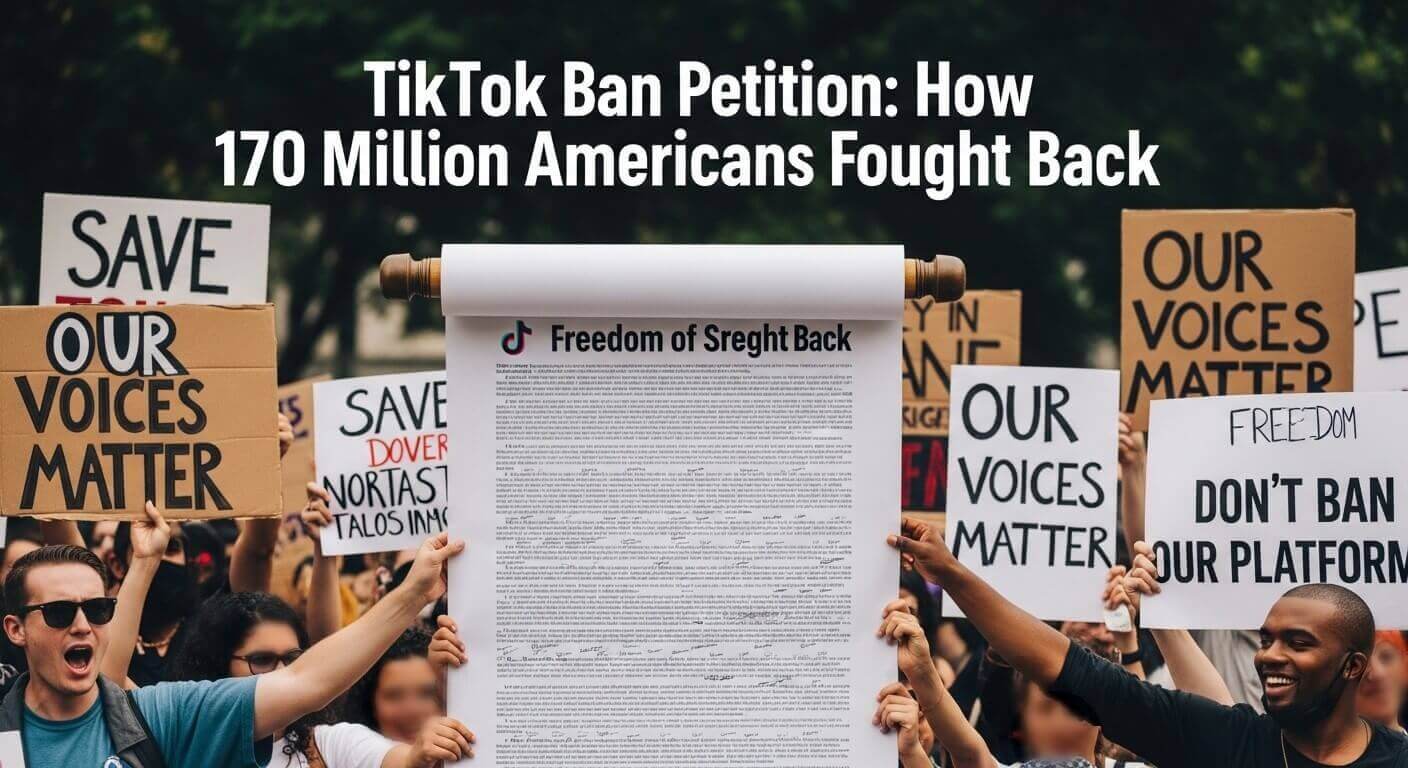
But before that dramatic shutdown, millions of Americans had fought back through petitions, protests, and legal battles. The TikTok ban petition became the largest digital rights movement in American history. Yet despite overwhelming public opposition, it failed.
Here’s the complete story of how everyday users, civil rights lawyers, and content creators battled the government—and what the controversial Oracle deal means for your digital future.
What Is the TikTok Ban Petition?
The Simple Explanation
The TikTok ban petition represents organized efforts by American citizens to stop the government from banning or forcing the sale of TikTok. When Congress passed a law requiring ByteDance (TikTok’s Chinese parent company) to sell the app by January 19, 2025, users launched massive petition campaigns.
The movement included multiple petition drives:
- ACLU’s legal petition urging Congress to repeal the ban act
- #DontBanTikTok grassroots movement demanding data privacy laws instead
- Individual Change.org petitions from creators and business owners
Why Did People Fight So Hard?
For 170 million Americans, TikTok wasn’t just entertainment. Content creators earned six-figure incomes. Small businesses found customers they couldn’t reach anywhere else. Communities formed around shared interests, mental health support, and creative expression.
When Congress threatened to take it all away, people fought back. They saw the ban as government overreach that violated their First Amendment free speech rights.
The Complete Timeline: From Law to Shutdown to Deal
April 2024: Congress Passes the Ban Law
Congress passed the Protecting Americans from Foreign Adversary Controlled Applications Act with rare bipartisan support. The law gave ByteDance nine months to divest from TikTok or face a complete U.S. shutdown.
Why? Lawmakers cited national security concerns. They argued that TikTok’s Chinese ownership gave Beijing potential access to American user data and the ability to spread propaganda.
Both Democrats and Republicans agreed—a warning sign for petition supporters.
Summer 2024: The Petition Movement Explodes
As the January 2025 deadline approached, petition campaigns gained momentum:
- The ACLU led the constitutional fight, arguing the ban violated free speech rights of more than 170 million Americans. They urged Congress to cosponsor the Repeal TikTok Ban Act, emphasizing that the government was censoring an entire communication platform.
- The #DontBanTikTok movement took a different approach. Instead of just opposing the ban, they demanded comprehensive data privacy laws protecting all internet users—not just targeting one app. Their petition argued that banning TikTok was “aggressive online censorship” that wouldn’t fix the real problem.
- Content creators shared personal stories through Change.org petitions. A single mother explained how TikTok income paid her mortgage. A small bakery owner showed how 80% of her customers came from TikTok. These weren’t just signatures—they were livelihoods hanging in the balance.
January 17, 2025: Supreme Court Crushes Petition Hopes
The Supreme Court unanimously upheld the ban law. This decision shocked petition supporters who believed free speech protections would prevail.
The Court applied “intermediate scrutiny” and found that Congress had substantial evidence of national security risks. The justices agreed that while TikTok enabled valuable expression, preventing potential Chinese government influence justified the restriction.
Translation: National security trumped free speech. Petition signatures couldn’t change that constitutional analysis.
January 18, 2025: TikTok Goes Dark
ByteDance pulled the trigger. TikTok disappeared from the Apple App Store and Google Play Store. Users opening the app saw a message: “A law banning TikTok has been enacted… We are fortunate that President Trump has indicated he will work with us on a solution.”
Panic rippled across social media. Creators redirected followers to Instagram and YouTube. Business owners scrambled for alternative marketing channels. Millions felt digitally silenced.
The blackout lasted less than 24 hours—but changed everything.
January 19, 2025: Trump’s Surprise Rescue
President Donald Trump, who had tried to ban TikTok during his first term, now saved it. He issued executive orders extending the deadline and instructing officials not to prosecute app stores for keeping TikTok available.
Within hours, TikTok restored service. But why did Trump change his position?
Political analysts point to several factors: TikTok’s importance to young voters, pressure from content creators, and Trump’s relationship with tech investors who saw business opportunities in a TikTok deal.
January 22, 2026: The Oracle Deal Emerges
After secretive negotiations, TikTok announced a complex restructuring. Oracle, Silver Lake, and MGX each acquired 15% stakes in TikTok USDS Joint Venture LLC. ByteDance retained 19.9% ownership.
Oracle would manage TikTok’s algorithm and U.S. user data, theoretically separating operations from Chinese control.
The controversy: ByteDance still maintains partial ownership and runs advertising operations. Critics immediately questioned whether this actually complies with the divestment law.
Why Did the TikTok Ban Petition Fail?
Reason 1: National Security Beats Free Speech
The Supreme Court made it clear: when foreign adversary control meets national security concerns, free speech protections have limits.
The justices didn’t dispute that TikTok facilitated valuable expression. They agreed that millions of Americans used it for communication, creativity, and business. But they concluded that preventing potential Chinese government surveillance and propaganda justified the restriction.
The petition movement’s strongest argument—First Amendment rights—was lost.
Reason 2: Bipartisan Consensus Is Nearly Unbreakable
When Democrats and Republicans agree on legislation, public petitions face impossible odds. The ban law was passed with overwhelming support from both parties.
Congress members heard from constituents opposing the ban, but they prioritized what they saw as a genuine security threat. Petition signatures couldn’t overcome that bipartisan security consensus.
Reason 3: No One Wanted to Buy TikTok Outright
The petition movement argued that alternatives existed to a ban. But here’s the problem: TikTok’s value comes from ByteDance’s algorithm and infrastructure.
Separating the app from its Chinese parent company proved nearly impossible. American investors didn’t want to buy TikTok without the algorithm. ByteDance didn’t want to sell its most valuable technology.
This technical reality undermined arguments that divestment was a simple alternative to banning.
Reason 4: The Movement Mobilized Too Late
By the time most users understood the threat, Congress had already passed the law with veto-proof majorities. The petition movement gained momentum during the summer and fall of 2024, months after the critical legislative debates.
Lesson learned: Digital rights activism needs to happen during policy formation, not after laws pass.
The Major Petition Campaigns Explained
ACLU: The Constitutional Warriors
The American Civil Liberties Union launched the most sophisticated legal campaign. Their petition urged Congress to pass the Repeal TikTok Ban Act, arguing that:
- The ban violated the free speech rights of 170 million users
- It set a dangerous precedent for government internet control
- Comprehensive data privacy laws were the real solution
- Targeting one app based on ownership was discriminatory
The ACLU’s petition gathered hundreds of thousands of signatures and legal support from constitutional scholars.
Why it mattered: The ACLU forced serious constitutional debate, even though they ultimately lost in court.
#DontBanTikTok: The Grassroots Movement
This decentralized campaign focused on systemic solutions rather than just defending TikTok. Their core message: “Fix data privacy for everyone, don’t just ban one app.”
The movement highlighted that Facebook, Instagram, and other American platforms collect similar data without facing bans. They argued that singling out TikTok was hypocritical without addressing broader privacy concerns.
Why it resonated: The argument made logical sense to millions who saw inconsistent government policy.
Creator Petitions: Economic Survival Stories
Thousands of individual petitions came from people whose livelihoods depended on TikTok. These personal stories put faces to the statistics:
- A veteran with PTSD who found community and income through TikTok
- A bakery that went from struggling to thriving through TikTok marketing
- A teacher who supplemented her salary with educational content
- A teenager who built a six-figure business before graduating high school
Why they mattered: These stories demonstrated real economic harm beyond abstract free speech arguments.
Amnesty International: A Different Approach
Not every petition opposed the ban. Amnesty International launched a safety-focused petition calling on TikTok to:
- Ban targeted advertising for younger users globally
- Stop hyper-personalizing the “For You” feed with potentially toxic content
- Improve transparency about content recommendation algorithms
Why it’s important: This petition showed that TikTok criticism existed beyond national security concerns.
The Oracle Deal: What Actually Happened?
The Basic Structure
Oracle, Silver Lake, and MGX each hold 15% stakes (45% total). ByteDance retains 19.9%. Other investors hold the remaining stakes.
Oracle manages TikTok’s algorithm retraining using U.S. user data. The idea: separate TikTok’s operations from Chinese control while technically satisfying the divestment law.
Why Critics Call It a “Fake Sale”
Legal experts immediately questioned whether the deal complies with the law. The Protecting Americans from Foreign Adversary Controlled Applications Act requires divestment from foreign adversary control.
- The problem: ByteDance still runs advertising operations and maintains partial ownership. Critics argue this constitutes “maintenance of operational relationship” that the law prohibits.
The Trump administration negotiated the deal in near-total secrecy. No public disclosure of valuation. No transparency about complete terms. This opacity fuels suspicion about what’s really happening behind closed doors.
The Political Influence Concern
Oracle CEO Larry Ellison is a longtime Trump ally and supporter. This raises uncomfortable questions:
Did TikTok trade Chinese government influence for American political influence?
If the algorithm and content moderation shift from ByteDance control to Oracle control, and Oracle has close Trump administration ties, could the platform favor certain political viewpoints?
Petition supporters who fought for platform independence worry they got neither Chinese nor American political neutrality.
What Users Actually Experience
For everyday TikTok users, the Oracle deal means:
- ✓ The app still works (for now) ✓ Your account and content remain accessible ✓ Creators can continue earning income ✓ Businesses can keep marketing
- ✗ Future platform control is uncertain ✗ Data handling practices may change ✗ Content policies could shift ✗ Another legal challenge could revive the ban
What This Means for Your Digital Rights
Precedent Set: Government Can Ban Foreign Apps
The TikTok case established that the U.S. government can regulate or ban social media platforms owned by foreign adversaries, even with massive American user bases.
This affects more than just TikTok. Other apps with Chinese, Russian, or Iranian ownership or investment could face similar treatment.
Your action step: Diversify your platform presence. Don’t build your entire business or audience on any single platform you don’t control.
Data Privacy Still Unprotected
Despite all the TikTok attention, Congress hasn’t passed comprehensive data privacy legislation. American companies continue collecting massive user data with minimal regulation.
- The irony: The government banned TikTok for potential Chinese data access while allowing American companies unrestricted data collection.
- What petition advocates got right: We need systemic data privacy laws, not app-specific bans.
Platform Dependence Is Dangerous
The TikTok saga revealed how vulnerable users are to platform disruption. Creators built six-figure businesses, only to face potential overnight destruction through government action.
Lessons for creators and businesses:
- Build email lists independent of platforms
- Maintain presence across multiple social networks
- Own your customer relationships directly
- Don’t rely solely on algorithm-driven discovery
Frequently Asked Questions
What was the TikTok ban petition?
The TikTok ban petition refers to organized campaigns by users and civil rights groups to stop the government from banning TikTok. The ACLU led legal petitions urging Congress to repeal the ban act, while grassroots movements like #DontBanTikTok demanded data privacy laws instead of app-specific bans. Despite millions of signatures representing TikTok’s 170 million American users, the petitions failed to prevent the Supreme Court from upholding the ban law in January 2025.
Why did the TikTok ban petition fail?
The petition failed because the Supreme Court unanimously ruled that national security concerns outweighed free speech protections. The Court found that Congress had substantial evidence of risks from TikTok’s Chinese ownership and that the law was narrowly tailored to address those specific risks. Additionally, rare bipartisan congressional support made the ban extremely difficult to overturn through public pressure alone.
How many people signed the TikTok ban petition?
Millions of Americans signed various anti-ban petitions across multiple platforms including Change.org, the ACLU campaign, and grassroots movements. While exact totals vary, the 170 million figure represents TikTok’s total U.S. user base—the number of Americans affected by the ban. The petition movement demonstrated massive public opposition, though it couldn’t change the Supreme Court’s constitutional analysis.
Does the Oracle deal satisfy the TikTok divestment law?
This remains legally disputed. While Oracle, Silver Lake, and MGX hold 45% combined stakes, ByteDance retains 19.9% ownership and continues running advertising operations. Legal experts question whether this constitutes true divestment since ByteDance maintains operational relationships that the law may prohibit. Future court challenges could determine if the deal actually complies with legal requirements.
Can TikTok still be banned after the Oracle deal?
Yes, potentially. If courts determine the Oracle arrangement violates the divestment law, ban enforcement could resume. Additionally, if Congress decides national security concerns aren’t adequately addressed, lawmakers could demand further restructuring or pass new legislation. The deal provides temporary stability but doesn’t guarantee TikTok’s permanent survival in the U.S. market.
What should TikTok creators do now?
Diversify immediately. Maintain active presence on Instagram Reels, YouTube Shorts, and other platforms. Build direct email lists and customer relationships independent of any social network. The TikTok ban petition failure demonstrated that even platforms with 170 million users face regulatory risks. Creators who depend on single platforms risk losing everything overnight if government policy changes.