
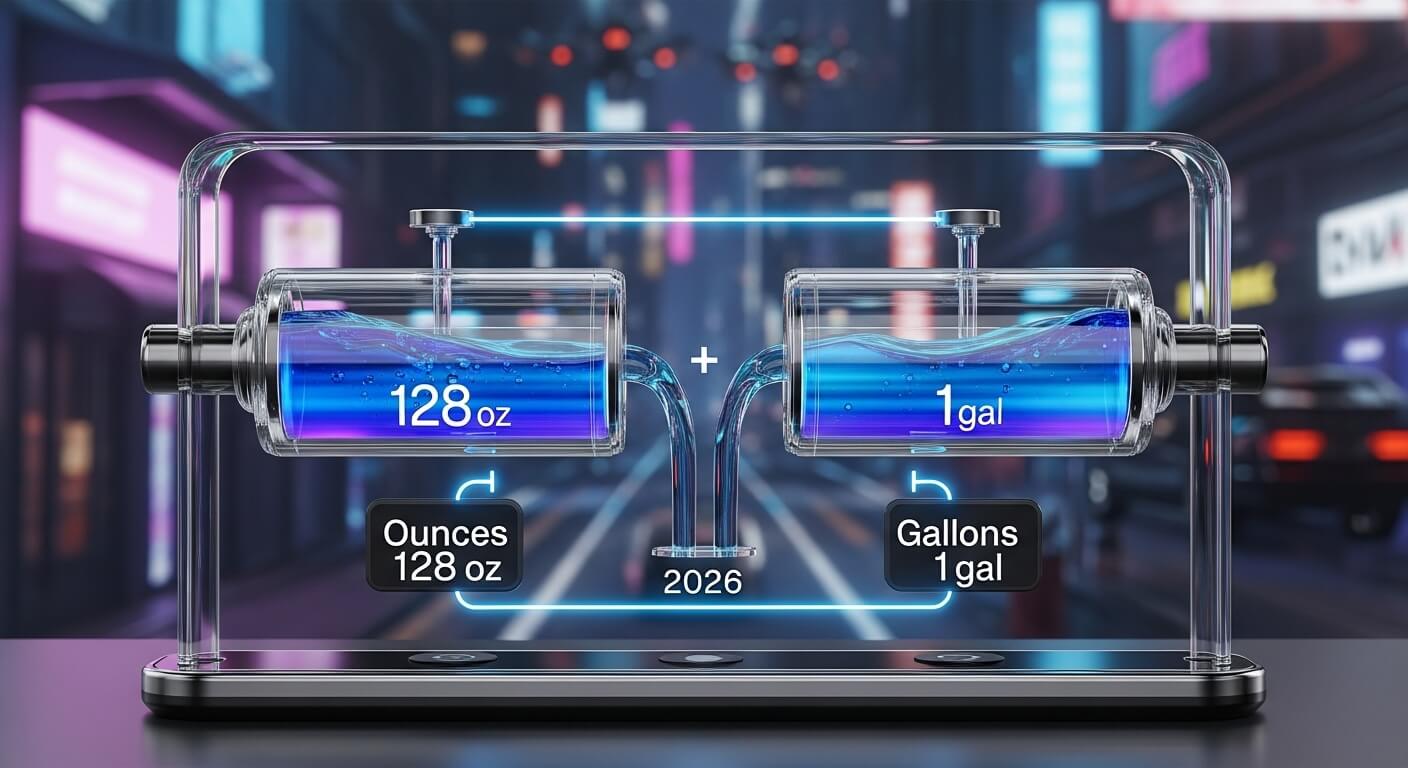
Need to convert ounces to gallons quickly and accurately? Whether you're measuring ingredients for a recipe, calculating beverage quantities, or working with liquid volumes in science or industry, understanding the oz to gallon conversion is essential. This comprehensive guide from WhatMobile PriceOye provides everything you need—from instant conversion tools to detailed explanations, practical examples, and expert tips for everyday use.
Table of Contents
Toggle🧮 Advanced Volume Converter
Convert between ounces, gallons, liters, and more. Enter value in any field for instant conversion!
⚡ Quick Conversions
💡 Tip: Enter values in either field for instant bidirectional conversion
Understanding the Oz to Gallon Conversion
The relationship between ounces and gallons is fundamental to the United States customary system of volume measurement. This conversion appears everywhere—from grocery shopping and recipe preparation to industrial liquid handling and scientific calculations.
At its core, the conversion is straightforward: 1 US gallon equals exactly 128 fluid ounces. This standard has been maintained consistently since the United States adopted the Queen Anne wine gallon in 1707, though it was officially defined more precisely in later years.
What Are Fluid Ounces?
A fluid ounce (abbreviated as fl oz or oz) is a unit of volume, not weight. This distinction is crucial because many people confuse fluid ounces with weight ounces. While 1 fluid ounce of water happens to weigh approximately 1 ounce, this relationship doesn't hold for other liquids.
For instance, 1 fluid ounce of honey weighs about 1.5 ounces due to its higher density. Therefore, when converting volumes, always use fluid ounces, not weight measurements.
What Is a Gallon?
A gallon is a larger unit of volume primarily used in the United States for measuring liquids. The US liquid gallon is defined as exactly 231 cubic inches, which equals 3.785411784 liters in the metric system.
Gallons are commonly used for:
- Milk and juice containers
- Gasoline and other automotive fluids
- Paint and industrial chemicals
- Water consumption tracking
- Agricultural and landscaping applications
💡 Quick Fact
The US gallon is based on the wine gallon, historically used for measuring wine. The British Imperial gallon, by contrast, was based on the volume of 10 pounds of water at specific conditions, making it about 20% larger than the US gallon.
The Simple Conversion Formula
Converting ounces to gallons requires only basic division. The formula is remarkably simple:
Gallons = Ounces ÷ 128Or, expressed algebraically:
G = oz / 128Where:
- G represents the number of gallons
- oz represents the number of fluid ounces
- 128 is the conversion factor (ounces per gallon)
Step-by-Step Conversion Process
Let's walk through a practical example. Suppose you have 64 ounces of orange juice and want to know how many gallons that represents:
- Identify your starting value: 64 fluid ounces
- Apply the formula: 64 ÷ 128 = 0.5
- Interpret the result: 64 ounces equals 0.5 gallons (or half a gallon)
Converting Gallons to Ounces
The reverse conversion is equally straightforward. To convert gallons to ounces, multiply by 128:
Ounces = Gallons × 128For example, if you need to convert 2.5 gallons to ounces:
2.5 × 128 = 320 ouncesQuick Reference: Common Conversions
These frequently-used conversions can save you time in daily calculations. Bookmark this section for quick reference:
(1 cup)
(1 pint)
(1 quart)
(Half gallon)
(Full gallon)
(Double gallon)
Bottle and Container Sizes
Understanding common container sizes helps with quick mental conversions:
- Standard water bottle: 16.9 oz (approximately 0.132 gallons)
- Sports bottle: 32 oz (0.25 gallons)
- Large water jug: 64 oz (0.5 gallons)
- Gallon milk jug: 128 oz (1 gallon)
- Two-liter bottle: 67.6 oz (approximately 0.528 gallons)
US Gallon vs Imperial Gallon: Key Differences
One common source of confusion in volume conversion arises from the difference between US and Imperial (UK) gallons. While both use the term "gallon," they represent different volumes.
US Gallon Specifications
- Volume: 128 US fluid ounces
- Metric equivalent: 3.785 liters
- Cubic inches: 231 cubic inches
- Used in: United States, some Latin American countries
Imperial Gallon Specifications
- Volume: 160 Imperial fluid ounces
- Metric equivalent: 4.546 liters
- Cubic inches: 277.42 cubic inches
- Used in: United Kingdom, Canada (partially), some Commonwealth nations
⚠️ Important Note
The Imperial gallon is approximately 20% larger than the US gallon. This means 128 US fluid ounces equals about 1 US gallon, but only 0.8 Imperial gallons. Always verify which system you're working with to avoid measurement errors.
Comparison Table: US vs Imperial
| Measurement | US System | Imperial System | Difference |
|---|---|---|---|
| 1 Gallon | 128 fl oz | 160 fl oz | +25% Imperial |
| 1 Gallon (Liters) | 3.785 L | 4.546 L | +0.761 L Imperial |
| 1 Quart | 32 fl oz | 40 fl oz | +25% Imperial |
| 1 Pint | 16 fl oz | 20 fl oz | +25% Imperial |
Practical Examples and Real-World Uses
Example 1: Water Intake Tracking
Health experts often recommend drinking eight 8-ounce glasses of water daily (the "8x8 rule"). Let's calculate how much this is in gallons:
8 glasses × 8 ounces = 64 ounces total
64 ounces ÷ 128 = 0.5 gallons (half a gallon per day)
Many people find it easier to visualize drinking half a gallon of water rather than counting individual glasses throughout the day.
Example 2: Recipe Scaling
Imagine you're making a large batch of soup for a community event. Your recipe calls for 1 gallon of chicken broth, but you can only find 32-ounce containers at the store. How many do you need?
1 gallon = 128 ounces
128 ounces ÷ 32 ounces per container = 4 containers
You'll need exactly four 32-ounce containers of chicken broth.
Example 3: Paint Coverage Calculation
Paint is often sold in gallons or quarts. If you have three quarts of paint and want to know the total volume in gallons:
1 quart = 32 ounces
3 quarts × 32 = 96 ounces
96 ounces ÷ 128 = 0.75 gallons
Example 4: Beverage Planning for Events
You're hosting a party and planning to serve lemonade. If each guest drinks approximately 20 ounces and you're expecting 50 guests:
50 guests × 20 ounces = 1,000 ounces needed
1,000 ounces ÷ 128 = 7.8125 gallons
You should prepare approximately 8 gallons of lemonade to ensure adequate supply.
Complete Oz to Gallon Conversion Table
This comprehensive table covers the most common conversions you'll encounter in daily life, cooking, and professional settings:
| Fluid Ounces (oz) | Gallons (exact) | Gallons (decimal) | Common Name |
|---|---|---|---|
| 8 oz | 1/16 gallon | 0.0625 | 1 Cup |
| 12 oz | 3/32 gallon | 0.09375 | Standard can |
| 16 oz | 1/8 gallon | 0.125 | 1 Pint |
| 20 oz | 5/32 gallon | 0.15625 | Small bottle |
| 32 oz | 1/4 gallon | 0.25 | 1 Quart |
| 40 oz | 5/16 gallon | 0.3125 | Large water bottle |
| 48 oz | 3/8 gallon | 0.375 | - |
| 64 oz | 1/2 gallon | 0.5 | Half gallon |
| 80 oz | 5/8 gallon | 0.625 | - |
| 96 oz | 3/4 gallon | 0.75 | 3 Quarts |
| 128 oz | 1 gallon | 1.0 | Full gallon |
| 192 oz | 1.5 gallons | 1.5 | - |
| 256 oz | 2 gallons | 2.0 | - |
| 384 oz | 3 gallons | 3.0 | - |
| 512 oz | 4 gallons | 4.0 | - |
Kitchen and Cooking Applications
In culinary contexts, accurate volume conversion is essential for recipe success. Understanding oz to gallon conversions helps when scaling recipes, planning meals, or shopping for ingredients.
Standard Cooking Measurements
Here's how ounces and gallons relate to common cooking measurements:
- 1 tablespoon = 0.5 fluid ounces
- 1 cup = 8 fluid ounces (0.0625 gallons)
- 1 pint = 16 fluid ounces (0.125 gallons)
- 1 quart = 32 fluid ounces (0.25 gallons)
- 1 gallon = 128 fluid ounces
Recipe Conversion Tips
When converting recipes from ounces to gallons or vice versa, keep these guidelines in mind:
- Maintain proportions: Convert all liquid ingredients consistently to avoid changing the recipe's balance
- Consider container sizes: Purchasing ingredients in gallon containers is often more economical for large batches
- Account for measurement precision: Small variations matter more in baking than in general cooking
- Use weight for dry ingredients: While we focus on volume here, remember that dry ingredients are more accurately measured by weight
Beverage Preparation Guide
| Servings Needed | Per-Person Amount | Total in Ounces | Total in Gallons |
|---|---|---|---|
| 10 people | 12 oz each | 120 oz | 0.94 gallons (≈1 gal) |
| 25 people | 12 oz each | 300 oz | 2.34 gallons (≈2.5 gal) |
| 50 people | 12 oz each | 600 oz | 4.69 gallons (≈5 gal) |
| 100 people | 12 oz each | 1,200 oz | 9.38 gallons (≈10 gal) |
Scientific and Industrial Applications
Beyond the kitchen, oz to gallon conversions play vital roles in various professional fields:
Laboratory and Research
In scientific settings, accurate volume measurements are critical for:
- Solution preparation: Creating specific concentrations of chemicals
- Sample collection: Standardizing sample volumes for consistency
- Equipment calibration: Ensuring measuring devices provide accurate readings
- Documentation: Recording precise volumes for reproducibility
Note that most modern laboratories use metric units (liters and milliliters), but understanding US customary conversions remains valuable when working with older equipment or US-specific protocols.
Automotive and Mechanical
In automotive contexts, fluid capacities are often specified in quarts or gallons:
- Engine oil: Typically 4-8 quarts (1-2 gallons)
- Coolant systems: Often 1-3 gallons
- Transmission fluid: Usually specified in quarts
- Fuel tanks: Measured in gallons (10-25 gallons for most vehicles)
Agriculture and Landscaping
Agricultural applications frequently involve large-scale liquid measurements:
- Irrigation planning: Calculating water requirements per acre
- Fertilizer mixing: Creating proper dilutions in gallon quantities
- Pesticide application: Following precise mixing ratios
- Livestock water consumption: Monitoring daily intake in gallons
Common Conversion Mistakes to Avoid
Even with a simple formula, several pitfalls can lead to conversion errors. Understanding these common mistakes helps ensure accuracy:
1. Confusing Fluid Ounces with Weight Ounces
This is perhaps the most frequent error. Remember:
- Fluid ounces (fl oz) measure volume
- Weight ounces (oz) measure mass
While these may coincidentally equal the same numerical value for water (1 fl oz of water weighs approximately 1 oz), this relationship doesn't hold for other substances. Always use fluid ounces when working with gallons.
2. Using Imperial Instead of US Measurements
As discussed earlier, the Imperial gallon (160 oz) differs significantly from the US gallon (128 oz). Using the wrong system introduces a 25% error in your calculations.
⚠️ Regional Awareness
When working with international colleagues or following recipes from other countries, always verify which measurement system is being used. A UK recipe calling for "1 gallon" actually requires 160 oz, not 128 oz.
3. Rounding Errors in Multi-Step Conversions
When performing conversions that involve multiple steps, premature rounding can accumulate errors. For best accuracy:
- Keep extra decimal places during intermediate calculations
- Round only at the final step
- Use a calculator for precision when dealing with large quantities
4. Forgetting the Conversion Factor
Some people mistakenly use 100 or 120 as the conversion factor instead of 128. Always remember:
1 US gallon = 128 fluid ounces (exactly)5. Mixing Dry and Liquid Measurements
Dry measuring cups and liquid measuring cups are designed differently and can yield different volumes for the same substance. When working with liquids and converting to gallons, always use liquid measures (fluid ounces).
Expert Tips for Accurate Measurements
Use Proper Measuring Tools
Invest in quality measuring equipment:
- Liquid measuring cups: Clear, graduated cups with spouts for liquids
- Measuring spoons: For small quantities
- Kitchen scale: For verifying weight-to-volume relationships
- Gallon containers: Clearly marked for easy reference
Mental Math Shortcuts
Develop quick estimation skills for common conversions:
- Half gallon = 64 oz: Easy to remember for water bottles
- Quart = 32 oz: A quarter of a gallon
- 16 oz = 1 pint: Think "a pint's a pound the world around" (approximately)
Temperature Considerations
Liquid volumes can change slightly with temperature due to thermal expansion. For most practical purposes, this effect is negligible, but for high-precision work:
- Standard measurements assume 68°F (20°C)
- Hot liquids expand slightly, cold liquids contract
- The effect is typically less than 1% for normal temperature ranges
When working with precise measurements in professional settings or using modern mobile technology for calculations, understanding these environmental factors helps ensure accuracy across different conditions.
Digital Tools and Apps
In 2025, numerous digital resources can help with conversions. From technology tools and calculators to smart kitchen devices, there are many ways to simplify volume measurements:
- Smartphone apps: Unit conversion apps with offline capability
- Smart kitchen devices: Scales and measuring cups with digital displays
- Voice assistants: "Hey Google, convert 96 ounces to gallons"
- Online calculators: Like the one embedded at the top of this article
Frequently Asked Questions
There are 128 fluid ounces in 1 US gallon. This is a standard measurement used across the United States for liquid volume. The conversion formula is: Gallons = Ounces ÷ 128. For example, if you have 256 ounces, dividing by 128 gives you exactly 2 gallons.
To convert ounces to gallons, divide the number of ounces by 128. For example: 64 oz ÷ 128 = 0.5 gallons (half gallon). For quick conversions, you can use our calculator at the top of this page for instant results. The formula works for any quantity—just remember that 128 ounces equals exactly one gallon.
Fluid ounces (fl oz) measure volume, while weight ounces (oz) measure mass. When converting to gallons, you must use fluid ounces. For water, 1 fluid ounce weighs approximately 1 ounce, but this relationship doesn't hold for other liquids. Honey, for instance, weighs about 1.5 ounces per fluid ounce due to its higher density. Always verify whether you're working with volume or weight measurements.
Eight 16 oz bottles equal one gallon. Here's the calculation: 1 gallon = 128 oz, and 128 ÷ 16 = 8 bottles. This is a common question for water intake tracking—if you're aiming to drink a gallon of water daily, you need to consume eight standard 16-ounce bottles. This also applies to other beverages sold in 16 oz containers.
No, they are different. A US gallon contains 128 US fluid ounces (3.785 liters), while a UK (Imperial) gallon contains 160 UK fluid ounces (4.546 liters). The UK gallon is approximately 20% larger than the US gallon. This difference originated from different historical definitions—the US gallon is based on the wine gallon, while the Imperial gallon is based on the volume of 10 pounds of water. Always verify which system you're using to avoid measurement errors.
A half gallon contains 64 fluid ounces. This is exactly half of the 128 ounces in a full gallon. Half-gallon containers are common for milk, juice, and ice cream. When shopping, you'll often see 64 oz labeled as "half gallon" or "1/2 gal" on product packaging.
There are 32 fluid ounces in one quart. A quart is one-quarter of a gallon, hence the name. Since a gallon has 128 ounces, dividing by 4 gives us 32 ounces per quart. This measurement is commonly used in cooking recipes, automotive fluids, and beverage containers.
To convert gallons to ounces, multiply the number of gallons by 128. For example: 2.5 gallons × 128 = 320 ounces. This reverse conversion is useful when you know the volume in gallons but need to purchase products sold in ounce quantities, or when scaling recipes up from gallon measurements.
The easiest way to remember is that 128 ounces = 1 gallon. You can also think of it in steps: 8 oz in a cup, 2 cups in a pint (16 oz), 2 pints in a quart (32 oz), and 4 quarts in a gallon (128 oz). Another memory aid: if you drink eight 16-oz water bottles, you've consumed exactly one gallon.
Four 32 oz bottles equal one gallon. Since 1 gallon = 128 oz, we calculate: 128 ÷ 32 = 4 bottles. These 32-ounce bottles (also known as quarts) are popular for sports drinks, juices, and larger water bottles. Remember that each 32 oz bottle represents one-quarter of a gallon.
The required accuracy depends on your application. For cooking and general use, rounding to two decimal places (0.01 gallons) is usually sufficient. For scientific or industrial applications, you may need precision to three or four decimal places. When measuring large quantities, small percentage errors become more significant, so use more precision for bulk measurements.
Yes, the fluid ounce to gallon conversion (128 oz = 1 gallon) applies to all liquids when measuring volume. However, note that different liquids have different densities, so while 128 fluid ounces of any liquid equals 1 gallon by volume, the weight will vary. For example, 1 gallon of water weighs about 8.34 pounds, while 1 gallon of honey weighs approximately 12 pounds due to its higher density.
Key Takeaways and Summary
Understanding the oz to gallon conversion is a fundamental skill that serves you well in countless daily situations. Let's recap the essential points:
- The golden rule: 1 US gallon = 128 fluid ounces exactly
- Conversion formula: Divide ounces by 128 to get gallons, or multiply gallons by 128 to get ounces
- Common conversions: 64 oz = 0.5 gallons (half gallon), 32 oz = 0.25 gallons (1 quart), 16 oz = 0.125 gallons (1 pint)
- Watch for confusion: Fluid ounces measure volume; weight ounces measure mass—use fluid ounces for gallon conversions
- US vs Imperial: The US gallon (128 oz) is 20% smaller than the Imperial gallon (160 oz)
- Practical applications: This conversion applies to cooking, beverage planning, scientific work, automotive maintenance, and many other fields
- Use tools wisely: While mental math works for simple conversions, calculators ensure accuracy for complex or large-scale calculations
Whether you're measuring ingredients for a family dinner, planning beverages for a large event, or working in a professional capacity, mastering this conversion saves time and prevents costly errors. Bookmark this guide and use our calculator tool whenever you need quick, accurate conversions.
💡 Pro Tip
For most daily purposes, remembering these three key values will handle 90% of your conversion needs: 128 oz = 1 gallon, 64 oz = half gallon, and 32 oz = 1 quart. Master these, and you'll rarely need a calculator for common measurements.
Additional Resources
To deepen your understanding of volume measurements and conversions, consider exploring these related topics on WhatMobile PriceOye:
- Metric to US conversions: Learn how liters relate to gallons and milliliters to ounces
- Weight vs volume: Understand the relationship between mass and volume for different substances
- Cooking measurement mastery: Explore the full range of kitchen measurements and equivalents
- Scientific notation: For handling very large or very small volumes in technical applications
- Historical measurements: Discover how volume measurements evolved over time
- Technology and tools: Explore more calculators and conversion utilities for everyday use
As measurement tools and standards continue to evolve in 2025, having a solid grasp of fundamental conversions like oz to gallon remains invaluable. Whether you're a home cook, professional chef, scientist, mechanic, or simply someone who wants to understand measurements better, this knowledge empowers you to work confidently with volumes in any context. For more helpful tools and technology guides, visit our tech resources section where we provide practical solutions for everyday challenges.
Was this guide helpful? Share it with others who might need accurate oz to gallon conversions! Visit WhatMobile PriceOye for more useful calculators and technology guides.