
Introduction
Every successful business seeks ways to work smarter, not harder. As companies grow, daily operations often become more complicated, leading to delays, higher costs, communication gaps, and wasted resources. This is where business process optimization (BPO) becomes essential.
Business process optimization is the practice of analyzing, improving, and streamlining business workflows to increase efficiency while reducing unnecessary costs and errors. Whether you’re running a small startup or managing a large enterprise, optimizing your processes helps teams become more productive, improves customer satisfaction, and supports long-term growth.
This guide explains everything you need to know about business process optimization, including its benefits, methods, best practices, common challenges, and practical examples.
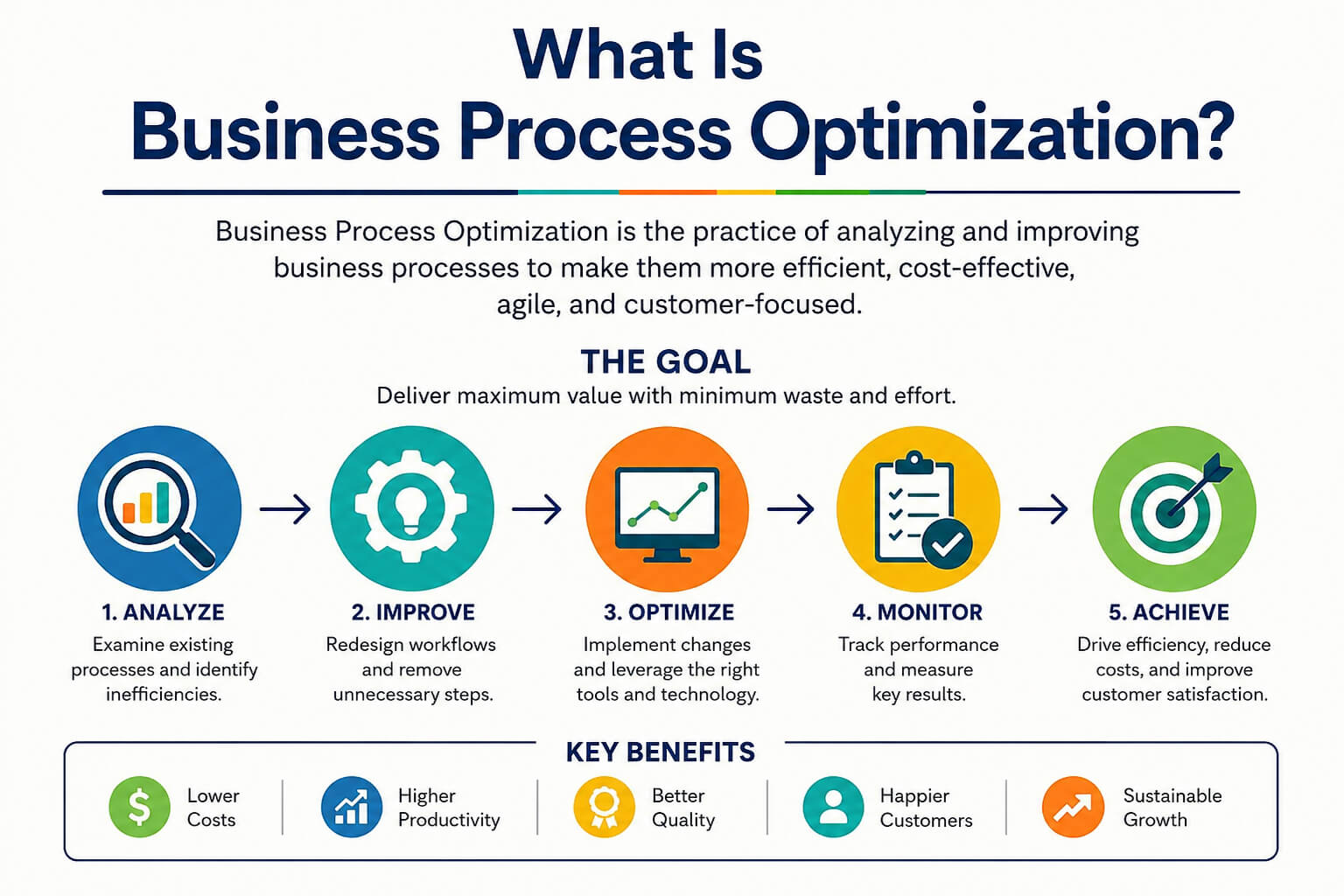
What Is Business Process Optimization?
Business process optimization is the continuous improvement of business operations by identifying inefficient workflows and replacing them with faster, smarter, and more effective processes.
Instead of simply working faster, optimization focuses on working better.
The goal is to eliminate unnecessary tasks while improving quality, consistency, and customer experience.
Key Objectives
- Reduce operational costs
- Increase productivity
- Improve workflow efficiency
- Minimize manual work
- Enhance customer satisfaction
- Reduce human errors
- Support business scalability
Why Business Process Optimization Matters
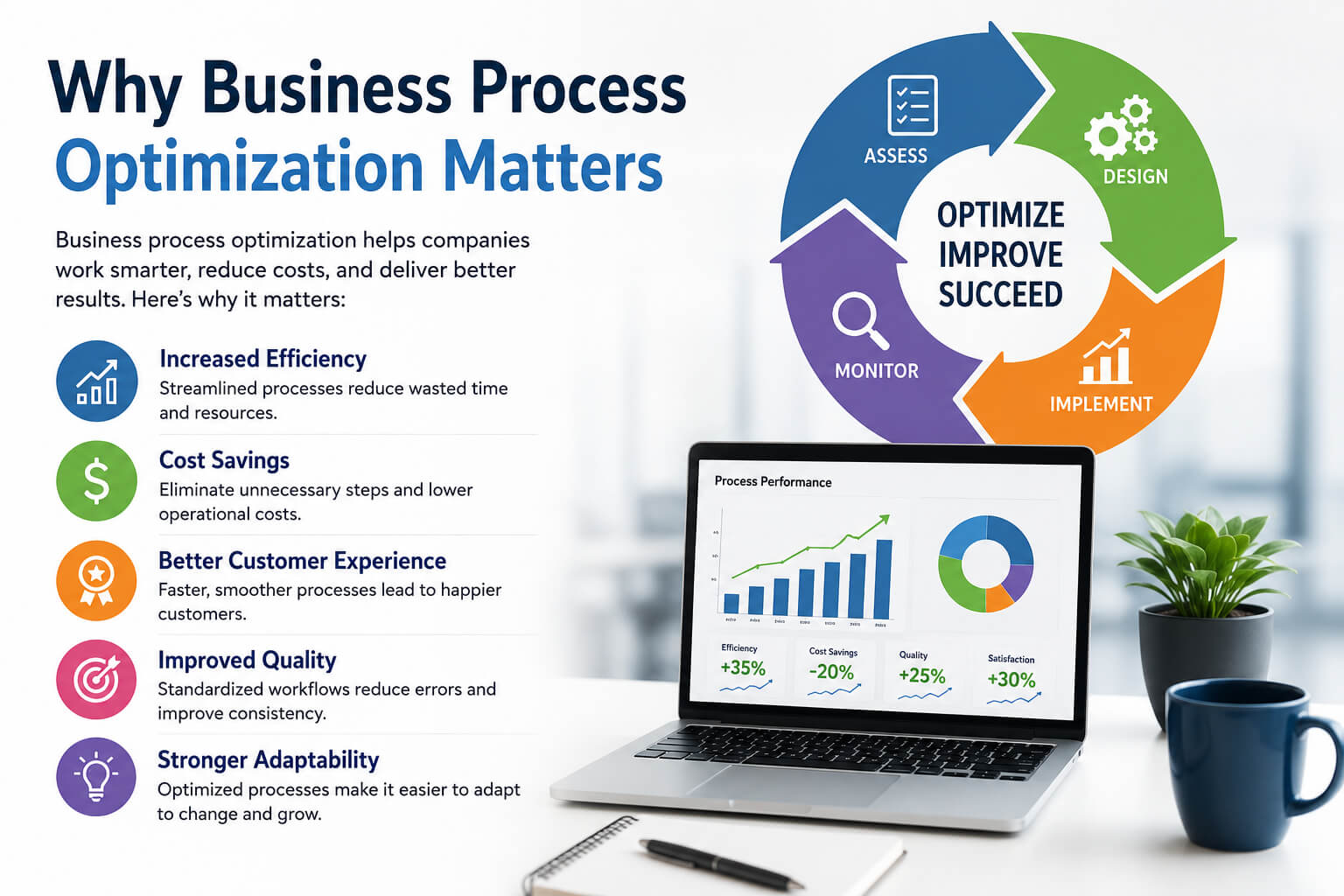
Modern businesses face increasing competition, changing customer expectations, and rapid technological advances.
Without optimized processes, organizations often experience:
- Missed deadlines
- Higher operating expenses
- Poor communication
- Slow customer service
- Employee frustration
- Reduced profitability
Process optimization helps businesses remain competitive while delivering better products and services.
Benefits of Business Process Optimization
Increased Operational Efficiency
Optimized workflows eliminate unnecessary steps, allowing employees to complete tasks faster without sacrificing quality.
Lower Business Costs
Removing waste and automating repetitive tasks significantly reduces operating expenses.
Examples include:
- Less paperwork
- Reduced overtime
- Lower processing costs
- Better resource allocation
Higher Employee Productivity
Employees spend less time on repetitive administrative work and more time focusing on valuable tasks.
Benefits include:
- Better collaboration
- Higher job satisfaction
- Faster project completion
- Improved accountability
Improved Customer Experience
Customers appreciate:
- Faster response times
- Accurate information
- Reliable service
- Consistent communication
Satisfied customers are more likely to become repeat buyers.
Better Decision-Making
Optimized processes generate cleaner data, allowing managers to make informed business decisions based on accurate insights.
Easier Business Growth
As organizations expand, optimized processes make it easier to onboard employees, manage operations, and handle increasing workloads.
Common Areas for Process Optimization
Almost every department can benefit from process improvement.
Sales
Examples include:
- Lead management
- Sales pipeline
- Proposal approvals
- Customer follow-up
Marketing
Marketing teams can optimize:
- Campaign planning
- Content approval
- Email marketing
- Social media scheduling
Human Resources
HR departments improve efficiency by optimizing:
- Recruitment
- Employee onboarding
- Performance reviews
- Leave management
Finance
Finance optimization often includes:
- Invoice processing
- Expense approvals
- Budget planning
- Financial reporting
Customer Service
Customer support benefits from:
- Automated ticket routing
- Faster issue resolution
- Self-service knowledge bases
- Standard response templates
Supply Chain
Businesses optimize:
- Inventory management
- Vendor communication
- Order fulfillment
- Shipping processes
Signs Your Business Needs Process Optimization
You may need optimization if your business experiences:
- Frequent mistakes
- Slow approvals
- Duplicate work
- Manual data entry
- Missed deadlines
- Customer complaints
- High operating costs
- Poor communication between departments
These issues often indicate inefficient workflows.
Business Process Optimization vs Business Process Improvement
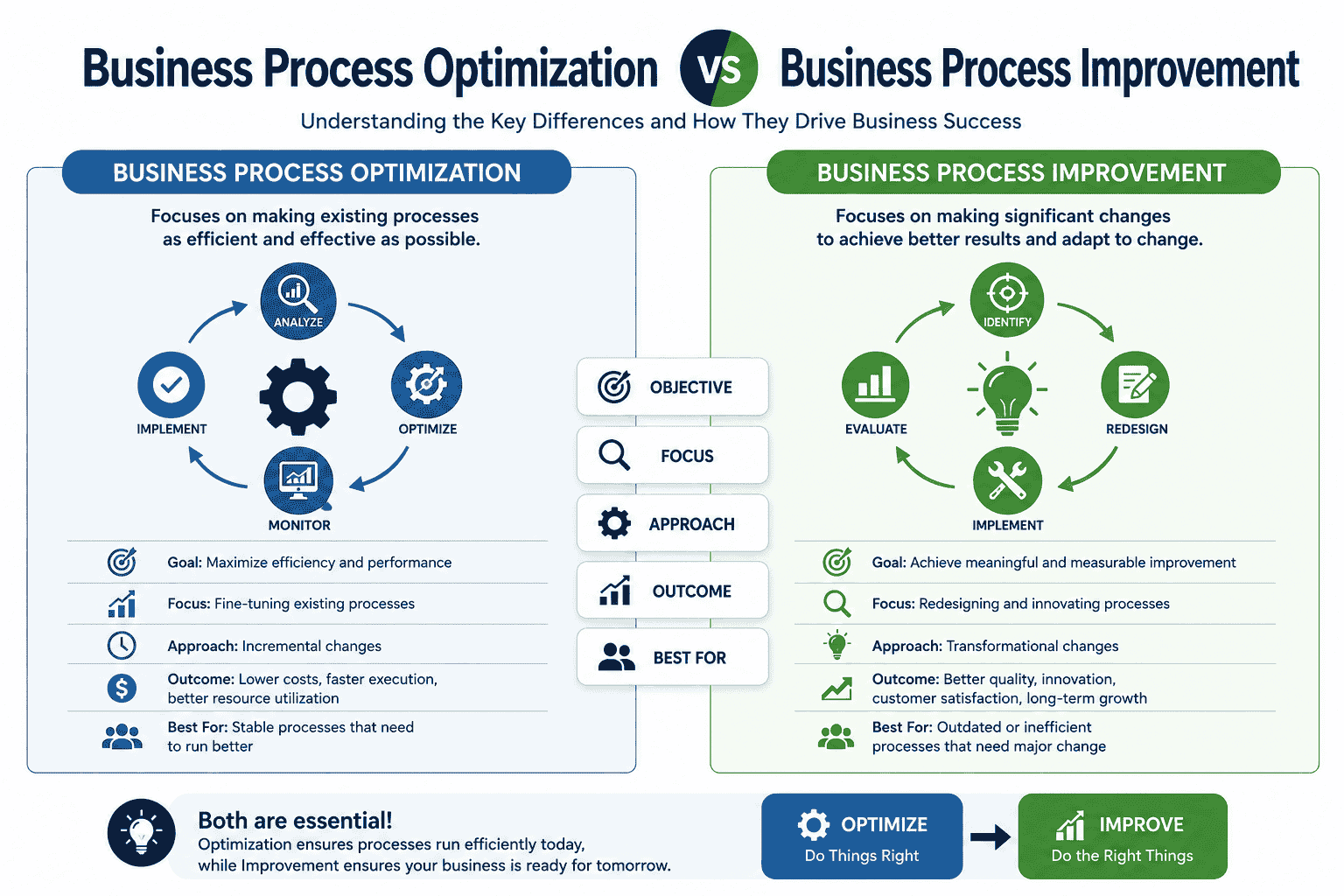
Although often used interchangeably, there are subtle differences.
| Business Process Improvement | Business Process Optimization |
|---|---|
| Focuses on gradual improvements | Focuses on maximizing efficiency |
| Solves existing problems | Prevents future inefficiencies |
| Usually project-based | Continuous strategy |
| Improves individual tasks | Optimizes complete workflows |
Both approaches work together to create better operations.
Steps in Business Process Optimization
Step 1: Identify Current Processes
Document every workflow from beginning to end.
Understand:
- Who performs each task
- Required tools
- Time taken
- Common delays
step 2: Analyze Existing Workflows
Look for:
- Bottlenecks
- Duplicate work
- Manual tasks
- Communication gaps
- Approval delays
Data analysis helps identify the biggest opportunities for improvement.
Step 3: Set Clear Goals
Examples include:
- Reduce processing time by 30%
- Cut operational costs by 20%
- Improve customer response time
- Increase productivity
Clear objectives guide optimization efforts.
Step 4: Design Improved Processes
Remove unnecessary steps while simplifying workflows.
Consider:
- Automation
- Standard procedures
- Better collaboration
- Digital tools
Step 5: Implement Changes
Roll out improvements gradually.
Provide:
- Employee training
- Documentation
- Support resources
- Performance monitoring
Step 6: Measure Results
Track Key Performance Indicators (KPIs) such as:
- Processing time
- Cost savings
- Customer satisfaction
- Employee productivity
- Error rates
Optimization should always be measurable.
Step 7: Continuously Improve
Business environments constantly evolve.
Regularly review workflows to identify new opportunities for improvement.
Continuous optimization keeps organizations competitive.
Popular Business Process Optimization Techniques
Lean Management
Lean focuses on eliminating waste while maximizing customer value.
Common forms of waste include:
- Waiting
- Overproduction
- Unnecessary movement
- Excess inventory
- Defects
Six Sigma
Six Sigma reduces process variation through data-driven analysis.
It helps improve:
- Quality
- Accuracy
- Consistency
- Customer satisfaction
Business Process Reengineering (BPR)
Rather than making small improvements, BPR redesigns entire business processes for dramatic performance gains.
Automation
Automation replaces repetitive manual work with software.
Examples include:
- Invoice approvals
- Email notifications
- Customer support chatbots
- Workflow automation
- Document management
Business Process Optimization Tools
Several software platforms support optimization efforts.
Popular categories include:
- Workflow management software
- Project management platforms
- Business intelligence tools
- Process mapping software
- Automation platforms
- CRM systems
- ERP solutions
The right tool depends on business size, industry, and operational needs.
Real-World Example
Imagine an online retailer processing customer orders manually.
Before optimization:
- Employees manually enter orders.
- Inventory updates take hours.
- Shipping labels are created individually.
- Customers wait days for updates.
After optimization:
- Orders sync automatically.
- Inventory updates instantly.
- Shipping labels are generated automatically.
- Customers receive real-time tracking.
Results:
- Faster deliveries
- Fewer errors
- Lower labor costs
- Higher customer satisfaction
Common Challenges
Optimization projects may encounter obstacles.
These include:
- Resistance to change
- Limited budgets
- Poor documentation
- Lack of leadership support
- Outdated technology
- Inadequate employee training
Strong planning and communication help overcome these challenges.
Best Practices
For successful optimization:
- Map every workflow clearly.
- Focus on customer value.
- Use reliable data.
- Involve employees.
- Automate repetitive work.
- Measure performance regularly.
- Review processes continuously.
- Encourage continuous improvement.
Small improvements made consistently often deliver significant long-term results.
Future Trends in Business Process Optimization
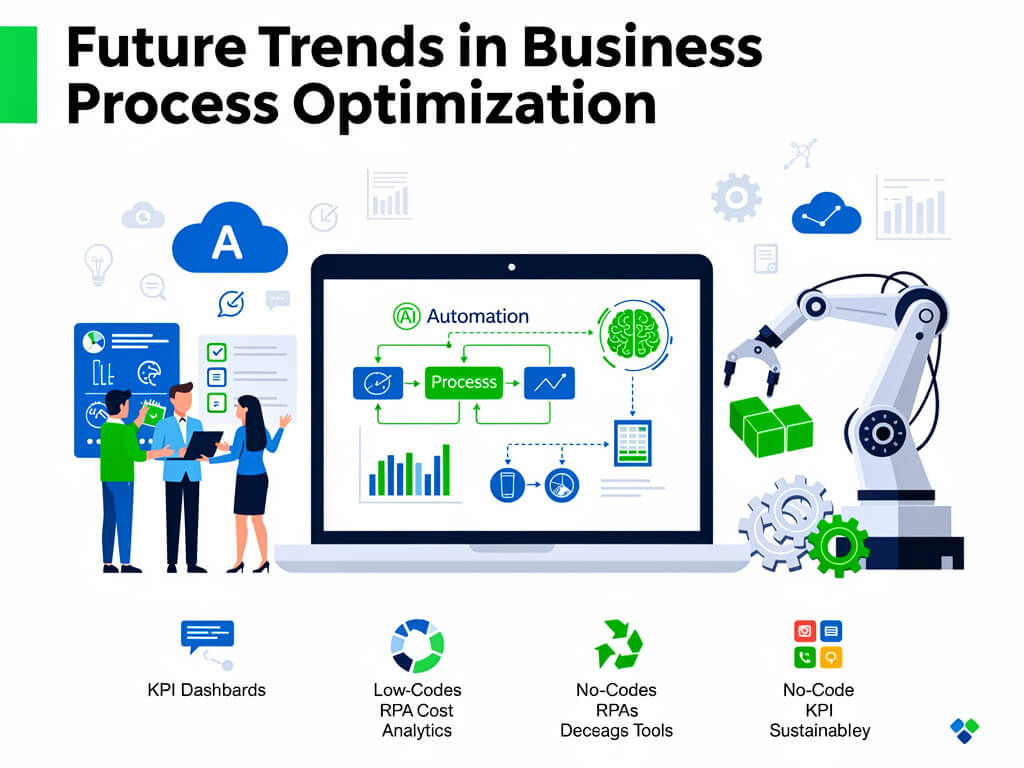
Businesses increasingly use advanced technologies to improve operations.
Emerging trends include:
Artificial Intelligence
AI helps predict problems, automate decisions, and improve customer interactions.
Robotic Process Automation (RPA)
Software robots handle repetitive digital tasks quickly and accurately.
Cloud-Based Workflows
Cloud platforms improve collaboration across remote teams.
Data Analytics
Real-time analytics identify inefficiencies and support faster decision-making.
Predictive Process Management
Businesses use predictive insights to solve problems before they affect operations.
Frequently Asked Questions (FAQs)
What is business process optimization?
Business process optimization is the practice of improving business workflows to increase efficiency, reduce costs, and deliver better outcomes.
Why is business process optimization important?
It helps organizations improve productivity, reduce waste, lower expenses, and provide better customer experiences.
What industries benefit from business process optimization?
Nearly every industry benefits, including healthcare, manufacturing, retail, finance, education, logistics, and technology.
What is the difference between automation and optimization?
Automation uses technology to perform tasks, while optimization improves the entire workflow. Automation is often one part of optimization.
How do companies measure process optimization success?
Businesses typically monitor KPIs such as processing time, operational costs, customer satisfaction, employee productivity, and error rates.
Is business process optimization only for large companies?
No. Small businesses often gain significant benefits because optimized workflows save time, reduce costs, and support growth.
How often should business processes be reviewed?
Organizations should review key processes regularly, especially after major business changes, technology upgrades, or customer feedback.
What are the first steps in optimizing a business process?
Begin by documenting current workflows, identifying bottlenecks, analyzing performance data, and setting measurable improvement goals.
Conclusion
Business process optimization is more than simply making tasks faster—it’s about creating smarter, more efficient ways of working that deliver lasting value. By analyzing workflows, removing inefficiencies, embracing automation where appropriate, and continuously measuring performance, businesses can reduce costs, improve productivity, and provide better experiences for both employees and customers.
Whether you’re a startup seeking sustainable growth or an established organization aiming to stay competitive, investing in business process optimization can lead to stronger operations, increased profitability, and long-term success. Continuous improvement is the key to adapting in today’s fast-changing business environment.