
Introduction
The way we communicate is changing faster than ever. For decades, mobile phones have depended almost entirely on cell towers to make calls and send messages. While this system works well in cities and towns, millions of people still live, work, or travel in areas where cellular coverage is weak or nonexistent.
This is where Starlink satellite calls on mobile phones are creating excitement. Instead of relying only on ground-based towers, compatible mobile phones can connect directly to satellites orbiting Earth. This technology has the potential to keep people connected almost anywhere, whether they are hiking in remote mountains, sailing across the ocean, or driving through rural highways.
In this guide, you’ll learn how Starlink satellite calls work, which phones are supported, their benefits, limitations, future possibilities, and what this technology means for everyday users.
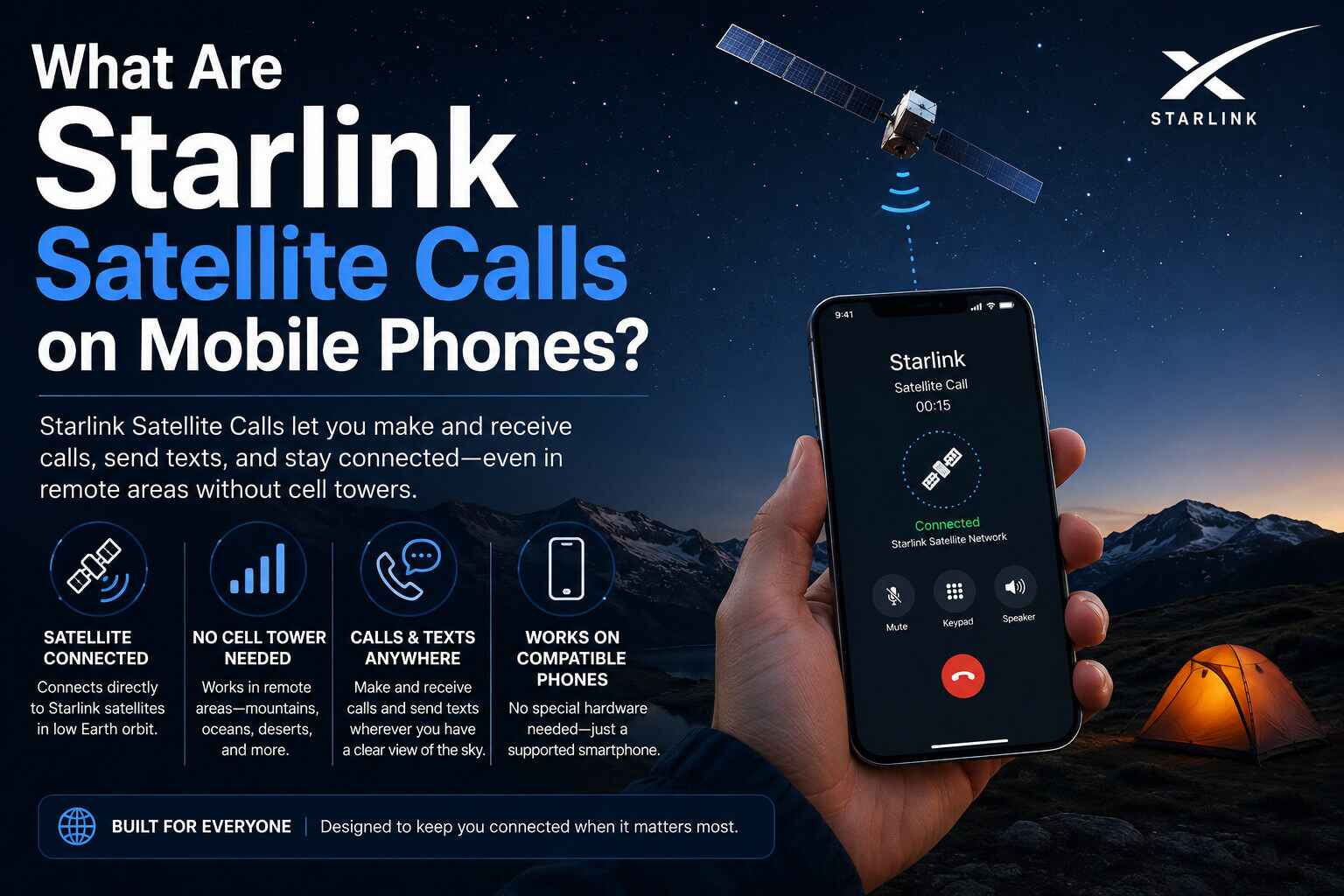
What Are Starlink Satellite Calls on Mobile Phones?
Starlink satellite calls on mobile phones allow users to communicate through satellites instead of depending entirely on traditional cellular towers.
The technology is developed by Starlink, the satellite internet service operated by SpaceX. Unlike conventional satellite phones that require specialized hardware, Starlink aims to let many existing smartphones communicate directly with satellites.
The goal is simple:
- Eliminate dead zones
- Improve emergency communication
- Expand connectivity worldwide
- Provide coverage where towers cannot reach
Instead of building thousands of additional cell towers, satellites orbiting the Earth can provide coverage over enormous areas.
How Starlink Satellite Calls Work
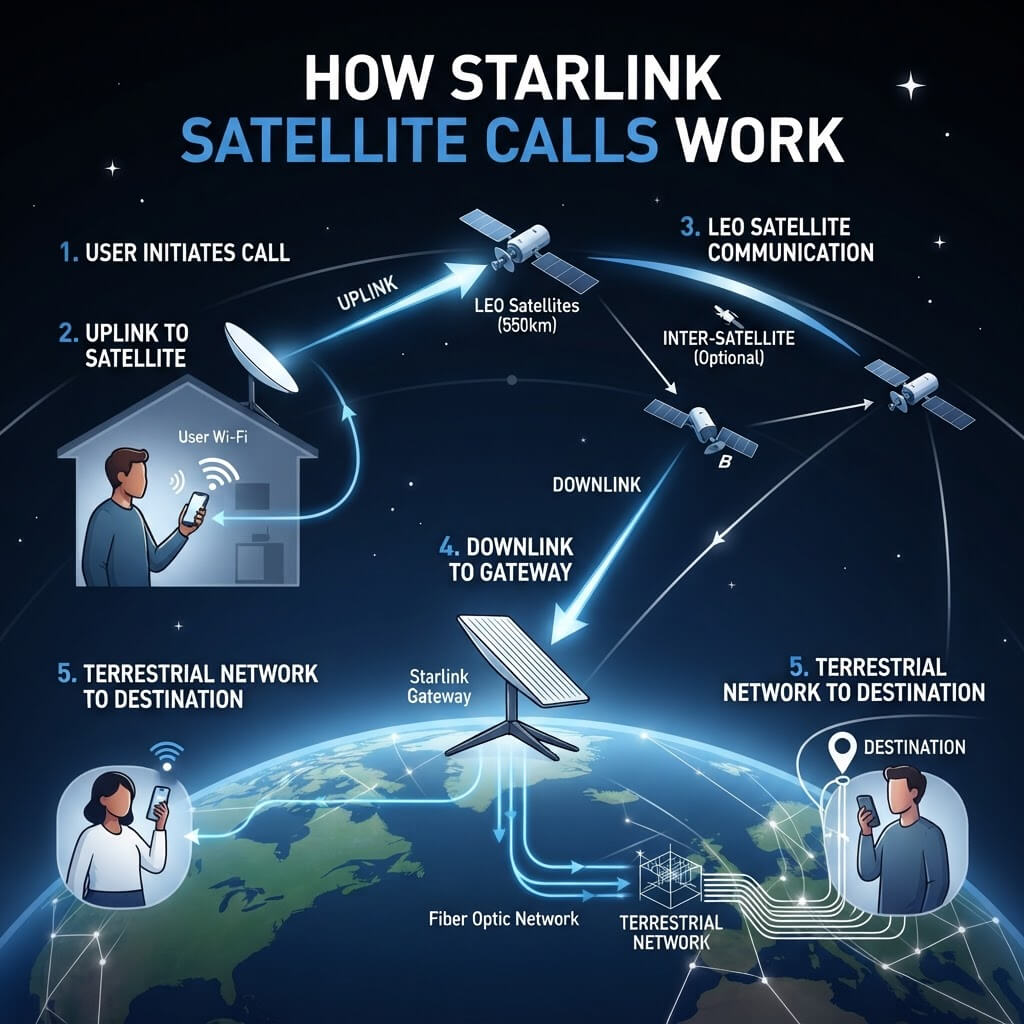
Understanding the technology is easier than it sounds.
Here’s the basic process:
- Your mobile phone searches for a signal.
- If no cellular tower is available, it looks for a compatible satellite connection.
- A Starlink satellite overhead receives the signal.
- The satellite forwards the communication to a ground station.
- The call or message reaches its destination.
Unlike traditional satellite phones with large antennas, newer smartphones use advanced software and radio technology to communicate with satellites using standard hardware.
This makes satellite calling much more practical for everyday users.
Why Starlink Is Different from Traditional Satellite Phones
Traditional satellite phones have existed for decades, but they come with several drawbacks:
- Expensive hardware
- Bulky design
- High call costs
- Limited adoption
Starlink changes this by making satellite connectivity available on regular smartphones.
| Traditional Satellite Phones | Starlink Mobile Calls |
|---|---|
| Special phone required | Compatible smartphone |
| Expensive equipment | Existing phone in many cases |
| High service costs | Carrier-based plans expected |
| Limited users | Millions of smartphone users |
| Manual satellite setup | Automatic connection |
This makes satellite communication much more accessible.
Why Starlink Satellite Calls Matter
Billions of people own smartphones, yet coverage gaps remain common.
Some situations where Starlink satellite calls become valuable include:
- Camping
- Hiking
- Mountain climbing
- Rural farming
- Long-distance trucking
- Ocean travel
- Emergency response
- Natural disasters
Imagine breaking down on an isolated highway with no cell signal.
Instead of waiting for another vehicle to pass, your phone could connect directly to a satellite and call for help.
That capability could save lives.
Areas That Benefit the Most
Starlink satellite connectivity is especially useful in locations where building cellular infrastructure is difficult.
Examples include:
Rural Communities
Many villages still lack reliable cellular coverage.
Satellite communication helps bridge this digital divide.
National Parks
Visitors often lose signal during outdoor adventures.
Satellite calls provide extra safety.
Oceans
Traditional mobile towers cannot cover open water.
Satellite communication keeps travelers connected.
Deserts
Large desert regions rarely have consistent mobile coverage.
Satellites provide reliable communication.
Mountains
Mountain terrain blocks many cellular signals.
Satellite coverage works across much larger areas.
Which Phones Support Starlink Satellite Calls?
Support depends on partnerships between mobile carriers, smartphone manufacturers, and Starlink.
Many modern smartphones already include hardware capable of satellite communication.
Future compatibility continues to expand through software updates and network improvements.
Generally, newer smartphones with advanced radio systems have the best chance of supporting satellite features.
Compatibility depends on:
- Carrier support
- Operating system updates
- Smartphone hardware
- Country availability
How Calls Differ from Cellular Calls
Although the experience is becoming similar, there are still differences.
Cellular Calls
- Connect through nearby towers
- Usually stronger indoors
- Faster call setup
- High bandwidth
Satellite Calls
- Connect to satellites overhead
- Work in remote areas
- Require clearer sky visibility
- May experience slightly higher latency
As satellite technology improves, these differences continue shrinking.
Can You Make Voice Calls?
The long-term vision includes full voice calling.
Current deployments are gradually expanding capabilities.
Features expected include:
- Voice calls
- Emergency calls
- SMS messaging
- Picture messaging
- Data services
- Internet access
Many early satellite systems initially focused on text messaging before adding voice support.
This phased rollout helps ensure reliable service.
Emergency Communication Benefits
One of the biggest advantages of it is emergency communication.
Natural disasters often damage:
- Cell towers
- Power grids
- Internet infrastructure
Satellites remain operational even when ground infrastructure fails.
Emergency responders may benefit from:
- Faster coordination
- Better location sharing
- Reliable communication
- Wider coverage
For individuals, this means help may still be reachable during emergencies.
Benefits of Starlink Satellite Calls
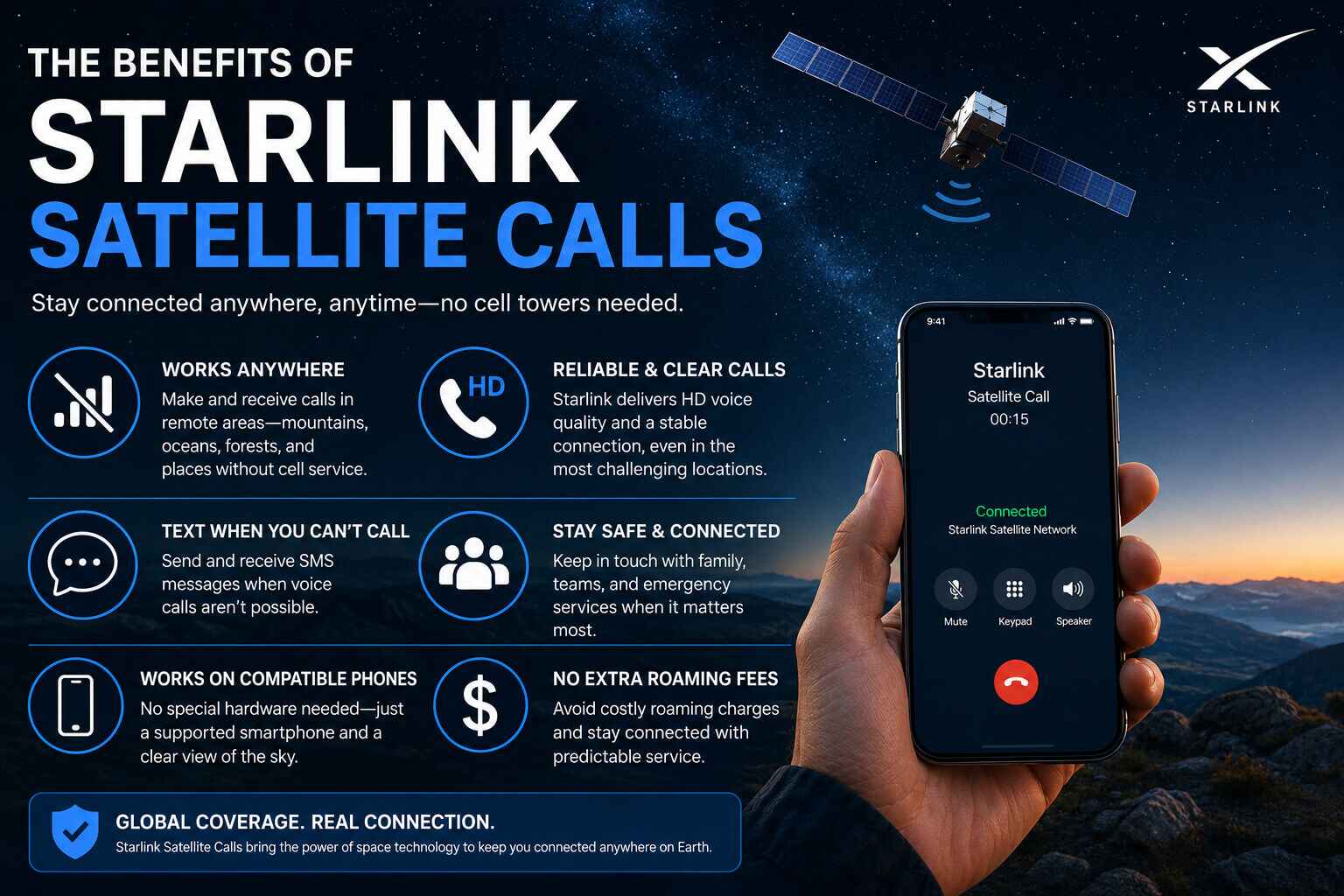
There are many reasons this technology is generating worldwide interest.
Nearly Global Coverage
Thousands of satellites orbit Earth continuously.
This creates coverage across vast regions.
Better Safety
People working alone or traveling remotely can stay connected.
Examples include:
- Farmers
- Miners
- Construction workers
- Researchers
- Adventure travelers
Reduced Dead Zones
Many current mobile black spots may eventually disappear.
Even remote highways could receive satellite coverage.
Easier Disaster Recovery
After earthquakes, hurricanes, floods, or wildfires, damaged towers often leave communities disconnected.
Satellite communication restores connectivity much faster.
No Extra Equipment
Unlike traditional satellite phones, users may not need additional hardware.
Their everyday smartphone becomes a communication device.
Limitations of Starlink Satellite Calls
Although exciting, the technology still has limitations.
Sky Visibility
Buildings, dense forests, tunnels, and underground areas may block satellite signals.
Open skies provide the best connection.
Slower Speeds
Satellite connections generally have higher latency than nearby cell towers.
Voice quality remains good, but internet speeds may vary.
Battery Usage
Searching for satellites may consume more battery power than regular cellular communication.
Service Availability
Availability depends on:
- Country regulations
- Mobile carrier partnerships
- Device compatibility
- Government approvals
Not every country supports the service yet.
How Many Starlink Satellites Are in Space?
Starlink has launched thousands of satellites into low Earth orbit.
This massive constellation continues growing every year.
The large number of satellites offers several advantages:
- Better global coverage
- Lower latency
- More reliable connections
- Increased network capacity
Low Earth orbit satellites travel much closer to Earth than traditional communication satellites.
This significantly reduces signal delay.
How Fast Is Satellite Communication?
Modern satellite communication is much faster than older systems.
Typical improvements include:
- Lower latency
- Faster message delivery
- Better voice quality
- More stable connections
Although satellite internet may not always match fiber-optic speeds, it is rapidly improving.
Will Satellite Calls Replace Cellular Towers?
Probably not.
Instead, the two technologies will work together.
Think of satellite communication as a backup network.
Cities will continue relying mostly on:
- 4G
- 5G
- Future 6G networks
Remote locations will increasingly benefit from satellite coverage.
This hybrid approach offers the best user experience.
Industries That Will Benefit
Many industries can gain from satellite-enabled mobile communication.
Agriculture
Farmers often work far from cell towers.
Satellite communication improves coordination.
Transportation
Truck drivers frequently cross remote highways.
Continuous communication enhances safety.
Maritime
Ships operating offshore remain connected.
Aviation
Future satellite communication may improve connectivity during flights.
Tourism
Outdoor adventure companies can better protect customers.
Energy
Oil, gas, mining, and renewable energy operations often occur in isolated regions.
Reliable communication supports safer operations.
Privacy and Security
Like any communication system, satellite calls require strong security.
Modern satellite networks typically use:
- Data encryption
- Secure authentication
- Network monitoring
- Software updates
Users should still follow standard cybersecurity practices, including:
- Strong passwords
- Device updates
- Two-factor authentication
- Trusted applications
Costs of Starlink Satellite Calls
Pricing models continue evolving.
Possible options include:
- Monthly carrier plans
- Premium emergency features
- Pay-per-use services
- Unlimited satellite messaging packages
Competition among providers may gradually reduce costs over time.
Starlink vs Other Satellite Services
Several companies are working to bring satellite communication to smartphones.
Here’s a general comparison.
| Feature | Starlink | Traditional Satellite Networks |
|---|---|---|
| Smartphone compatibility | High | Usually limited |
| Network expansion | Rapid | Slower |
| Satellite count | Very large | Smaller constellations |
| Consumer focus | Strong | Mostly enterprise |
| Future scalability | Excellent | Moderate |
As competition grows, consumers can expect more choices and better pricing.
Future of Starlink Satellite Calls on Mobile Phones
The future looks promising.
Experts expect continuous improvements, including:
- Better voice quality
- Faster satellite internet
- Higher data speeds
- Video calling support
- Wider smartphone compatibility
- Improved battery efficiency
- Lower service costs
Satellite communication could eventually become a standard feature on nearly every smartphone.
Just as Wi-Fi and Bluetooth became everyday technologies, satellite connectivity may become equally common.
Tips for Using Starlink Satellite Calls
To get the best experience:
- Stay in an open area.
- Keep your phone updated.
- Check your carrier’s compatibility.
- Maintain sufficient battery life.
- Enable satellite communication settings if available.
- Understand emergency features before traveling.
Preparation ensures reliable communication when you need it most.
Frequently Asked Questions
Can I use Starlink satellite calls anywhere?
Coverage is expanding rapidly, but availability depends on your location, mobile carrier, regulations, and compatible device.
Do I need a special satellite phone?
No. The goal is to support compatible everyday smartphones rather than requiring dedicated satellite phones.
Will satellite calls work indoors?
They work best with a clear view of the sky. Buildings, underground areas, and dense obstacles can weaken or block the signal.
Are satellite calls expensive?
Costs vary depending on carriers and service plans. As adoption grows, pricing is expected to become more competitive.
Can I use satellite calls during emergencies?
Yes. Emergency communication is one of the primary benefits of satellite-enabled mobile connectivity, especially in areas without cellular coverage.
Is the internet available through Starlink satellites on phones?
The technology is evolving. Messaging is typically introduced first, with voice and data services expanding as networks mature.
Final Thoughts
represent one of the most significant advances in mobile communication in recent years. By extending connectivity beyond the limits of traditional cell towers, this technology has the potential to reduce dead zones, improve emergency response, and make staying connected possible in once unreachable places.
While the service is still expanding and availability depends on compatible devices, carrier partnerships, and regional regulations, its long-term impact is clear. As more satellites are launched and smartphone support grows, satellite calling is expected to become a practical feature for millions of users worldwide.